by Nicole Zihua Zhang
Directed by Robert Zemeckis, the film Back to the Future tells the story of Martin, born into an ordinary family, who travels back in time in a time machine invented by Dr. Brown in order to change his parents’ character flaws and correct the family’s historical fate. In this way, it reflects an America that is repairing its wounds. In the exhibition ‘Back to the Future’: in the dance hall, the crowd is like zombies doing mechanical movements in the smoke; a huge ‘artificial moon’ luminous body made of polarised lenses; concrete-grown cacti; a mechanical arm writing a novel automatically; soap scattered all over the floor after hitting the wall; Kikachick taking the first step towards the stage, which is illuminated in a deep blue twilight and the falling snow glows faintly… The lights dazzle the eyes, the atmosphere is psychedelic and ambiguous. Before you know it, you are already caught up in the carefully arranged ‘degree of dreaminess’ by the unfamiliar yet familiar atmosphere, and fall into it. In the name of cinema, it showcases a future facing the past, conjures up time and memory, and initiates artistic actions that create possibilities.
The first exhibition of the He Art Museum in 2022, ‘ON|OFF 2021: Back to the Future,’ attempts to interpret the recent trend of looking back on reality in Chinese contemporary art practice as an action of creating the future. The exhibition concept was proposed by curator Sun Dongdong, whose work focuses on the state and evolution of Chinese contemporary art in the post-Olympic era and the construction of the image of the Chinese contemporary art system. The exhibition is divided into three units: ‘Time Attitude’, ‘Memory Space’ and ‘Multiple Echoes’.
The sense of a space theatre is fully reflected in this exhibition. In the ‘Time Attitude’ unit on the first floor, two works from the ‘In the Waves’ series by the artist Chen Wei, together with ‘Failure (Where Are You Going Tonight)’ and ‘S’, create a nightclub where the audience has left. Behind this cheap PVC material, there is a deeper sense of danger and insecurity. The people in ‘In the Waves’ gather together, dancing in the dance hall and shaking their heads at the music festival, but the smoke is filled with a sense of loss of not knowing where to go. ‘S’ and ‘Failure (Where Are You Going Tonight)’ amplify the ‘desolate’ atmosphere of the entire environment, as if it were a forgotten ruin.
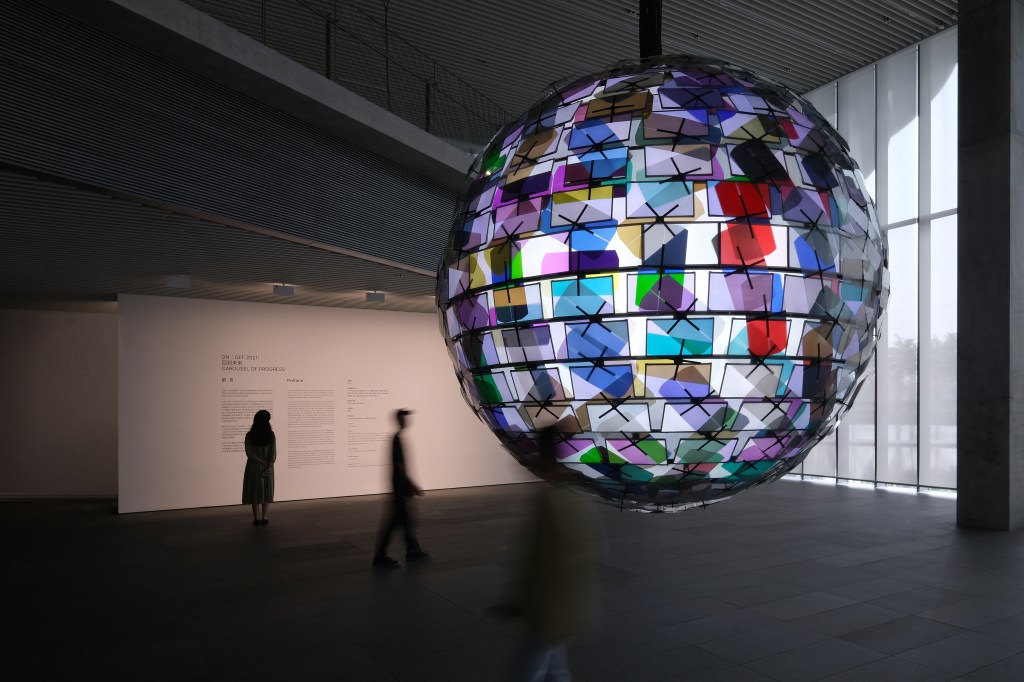
Wang Yuyang’s ‘Artificial Moon 2’ is a huge moon suspended in midair and made up of multiple screens, covered with rotating polarising films. The polarising films move randomly, constantly refracting and reflecting light. The white surface of the moon, which is normally hidden by the screens, absorbs everyone’s sensory experience and creates a unique sense of time.
‘The Faraway Circles Are You (Part 1: Like Stars)’ and “The Faraway Circles Are You (Part 2: Like Grains)” are new works created by the artist Chen Zhe for this exhibition. With the celestial pole indicated by the Earth’s rotation axis as the centre, the stars rotate eternally on the night sky. The artist takes a long exposure of their trajectory, developing countless concentric circles. On the other side of this mechanical movement device, the artist gently covers the water surface with the palm of his hand, so that the fingerprint is pressed just above the critical edge. The water droplets that are pulled away and fall down cause ripples that keep appearing and disappearing, turning into countless concentric circles in slow motion photography. The two works are placed on either side of the same giant black square, with a structure of one body and two sides that responds to the alchemical maxim ‘as above, so below’ from both the macro and micro scales.
As soon as you enter the second unit, ‘Memory Space,’ Li Ran transforms the delicate, minimalist exhibition space into a stage—the installation work ‘Untitled—Future Drama, Whatever You Say Is Fine,’ which is set in a scene. This stage is composed of message slips, lighting, piles of leaves and paper balls, venetian blinds, mattresses, coats, and drying racks, creating an intimate space. The audience is invited to walk through it. At this point, the artist exits the stage and becomes an invisible director, and the audience becomes the actors. walking among them, forcing the viewer to imagine the narrative that could happen. A DV player is placed by the wall playing in a loop the process of setting up this scene, hinting at the fictional nature of the exhibition itself.
In the space constructed with scaffolding, Zhang Ruyi’s two works ‘Soaking Landscape’ and ‘Dark Objects – Like the Wind Blowing’ become interlocutors. A series of elements such as cacti, fish tanks, steel bars, concrete blocks, and scavengers form the outline of an abstract structure, attempting to bring together everyday parts and the urban structure.
Wang Tuo’s video work ‘Obsession Record’ originated from the artist’s concern about a mysterious disappearance case, which in turn triggered his discussion on the desire and obsession in the Internet era, architectural aesthetics and otaku culture. The monologue in the work implies that an architect is being hypnotised by a psychotherapist, who is trying to make the architect imagine himself as a building. By exploring the internal structure of the building through the process of entering from the outside to the inside, the therapist penetrates layer by layer into the depths of this person’s heart and discovers the ‘secret room’ hidden in the building and the subconscious.
Entering the exhibition hall of Tao Hui’s works is like travelling back in time to the Republic of China period. There are three photographs from the ‘Leng Shuihua in his youth’ series hanging in the space between the yellowed floor tiles and walls. The ‘writing robotic arm’ is placed on the desk in the corridor, and the robotic arm that is still writing seems to be driven by the intentions of the viewers lingering here. In the adjacent exhibition space, a rare interview video is playing (‘Interview with Leng Shuihua, Author of A History of Southern Drama’). In her seventies, Ms Leng decides to clarify to the reporter an incident that caused a sensation when she was young. More than forty years ago, her lover copied her manuscript recording her emotional life without her permission and adapted it into a movie. Through the images, the viewer can see that Ms Leng is still angry about her former betrayal. During her three-week residency in Taipei, the artist stayed in a two-storey house with a garden in Tianmu, where she invented the character of the writer Leng Shuihua and her only work in her life, A History of Southern Drama. The setting of A History of Southern Drama spans the period from 1931 to 1981, across the strait, and lasts for half a century, incorporating the writer’s ‘personal experiences and hearsay records’.
Compared to the calm, restrained atmosphere of the exhibition spaces on the first and second floors, the atmosphere and rhythm of the ‘Multiple Echoes’ exhibition hall is more gentle and pulsating. The clear and concise shapes and the diversity of colours in the works ‘My Five Senses’ and ‘GOOD’ by the artist Gao Ludi dominate the visual impact. As the youngest artist born in the 1990s in the entire exhibition, Gao Ludi subtly captures the most obvious social symptoms of modern people in a relaxed and playful manner through careful deliberation of the structure of the picture and the colour relationship: faces with no visible facial features due to the use of masks, faces that conceal emotions, and thumbs up at any time and in any place.
Ma Qiusha’s ‘Wonderland’ series began in 2014. In creating the works in this series, the artist smashed cement boards, then wrapped the fragments in stockings of different colours, before reassembling the cement fragments into their original form. During the process of collecting the stockings and creating the work, Ma Qiusha used transparent nail polish to repair the scratches on the stockings. This was a method commonly used by her mother’s generation to repair stockings before the era of overproduction. The intimacy and collectivity of the body, the temperature of the historical memories contained in intimate objects, and the different perceptions of the female body across generations symbolised by stockings are all interwoven in the images of ‘Tiantelan’.
Close The work ‘Kikachick is taking its first steps towards the stage, where the falling snow glitters faintly in the light reflecting off the surface in the deep blue dusk’ from this exhibition is placed on tatami mats. Rounded cherries are scattered on the floor, their soft, juicy insides cut open and decorated with smooth black grains. The motorcycle fuel cap on top of the cherry extends a robotic arm towards the audience, as if waiting to be picked up. The artist’s assembly and collage are not random stacking or piling; they are neat and symmetrical, carefully considered ‘character moulding’.
Return, repetition and spiral are the curatorial concepts highlighted in this exhibition. For example, the maze image of Xu Qu’s ‘Labyrinth-Red Line’ placed at the end of the ‘Memory Space’ exhibition hall is full of interlacing and return, reflecting the world we live in, while echoing the ‘Miracle’ series of works on display in the ‘Time Attitude’ exhibition hall. Speaking of the curatorial concept, curator Sun Dongdong said: ‘On the one hand, it is out of a poetic comparison with the spatial form of the museum; on the other hand, it is an attempt to let the viewer, through the overlapping and accumulation of concepts between the works, sense the cosmic perspective jointly constructed by the museum space and the exhibition space in the rhythm of time and life, the global and the local, and memory and history.’
‘ON|OFF’ comes from the interface of the commercial VPN (virtual private network) protocol, with ‘ON’ being online and ‘OFF’ being offline. Simple binary oppositional narratives such as ‘prohibition and transgression’ or ‘authoritarianism and freedom’ are not the focus of the exhibition. What is important is the ‘|’ between ‘ON’ and ‘OFF’, which implies switching between the two states, isomorphism and coexistence. The ‘ON|OFF’ exhibition had a very straightforward original intention. In 2009, Philip Tinari was the founding editor-in-chief of LEAP magazine, and I was also a member of the team. While working on the magazine, we discovered a phenomenon together: after the financial crisis, the exhibition system and gallery system of Chinese contemporary art began to see the emergence of young artists. This is because when many of the previous generation of artists were launched, they were guided by external perspectives, such as Western curators, Western collectors, and the Western market. After the market bubble burst, galleries suddenly realised that the vitality of these artists’ practices was beginning to decline, and they turned their attention to some new young artists. In other words, these young artists who emerged later were artists cultivated within the Chinese contemporary art system. Until 2012, when Philip Tinari left LEAP to become director of the UCCA, he invited Bao Dong and me to co-curate this exhibition, and the subtitle of the ‘ON|OFF’ exhibition became the focus of the entire exhibition,’ curator Sun Dongdong said in an interview.
After a lapse of nine years, Sun Dongdong revisited the continuation and development of this theme in recent years. He said: ‘In 2017, I realised that “ON|OFF” is no longer a question that addresses a particular phenomenon. In recent years, during the accelerated development of globalisation, black swan events have continued to occur internationally, causing “ON|OFF” to become a defining characteristic of the times. The reason I have rethought and presented this exhibition is that the geopolitical and political nature of globalisation has been projected into everyday life, creating a tension between ‘integration and decoupling’. The future development and goals of the previous generation were predetermined. The so-called new hope actually follows the established world order. Nowadays, the global economic structure has undergone tremendous changes. Many scholars in the West say that our era has no defining characteristics, that is, it is an era without an era. Why? It means that there is no longer any way to establish a new future for all of humanity to strive for. In other words, when the future that the real world offers at the moment can already be predicted as not being a good one, we will inevitably want to find a common goal for the future. That is why, in the exhibition ‘ON|OFF 2021: Back to the Future’, I want to invite the audience to reflect on the past and consider what possibilities it offers for the future. This is the idea behind the exhibition.”
Nearly half of the artists on the list of this exhibition have participated in the two editions of ‘ON|OFF’. It is this kind of scrutiny that allows the viewer to directly see the growth and changes of this group. For example, He Xiangyu moved to Berlin, Germany, an important European art centre. There, he saw many issues related to European immigration and refugees, as well as Asian identity issues. The geographical tension led to his internal quest to think about identity. A series of works he has recently done are all about establishing a broad image of the East.
The second half of the exhibition title, ‘Back to the Future’, is inspired by the names of the Hollywood science fiction comedy film Back to the Future and the Carousel of Progress show on the rotating stage at Disneyland. ‘Back to the Future’ shows the self-reflective nature of the Chinese contemporary art system, which has become increasingly clear in recent years, and the resulting awareness and ability to return to one’s own emotional memories and historical experiences. This is not only evident in the artists’ practices, but also in the establishment and operation of the He Art Museum in Shunde Beijiao. Shunde was one of the earliest sites of experimentation and practice in China’s reform and opening up. The establishment of the He Art Museum represents, on the one hand, a transformation and upgrade of the city’s image, and on the other hand, it also heralds the Chinese art museum system’s transcendence of the thinking constraints of the so-called “big cities” and its entry into a more organic, socially-connected and radiating environment, which is very similar to the historical experience of China’s reform and opening up. ‘Back to the Future’ also revisits the historical experience of reform and opening up, and is inspiring for the future construction of China’s contemporary art system.
In the opinion of the curator, another dimension of the exhibition that brings us to think is “how to change the top-down exhibition thinking and build an intrinsic connection between contemporary art and the public at the social level.”
Shao Shu, executive director of the art museum, revealed that preparations for exhibitions at the art museum generally begin 2-3 years in advance. Plans have been made up to 2025, with the rhythm of exhibitions each year being based on seasons. The art museum will feature art with attributes of Guangdong (coastal) cultural trends, and will be compatible with the contemporary and modern, international and local, classic and cutting-edge. Due to the pandemic, the biggest adjustment the museum had to make before its opening was to postpone the exhibition schedule. The first exhibition of 2022, ‘ON|OFF 2021: Back to the Future,’ was confirmed even before the museum building was topped out. This is a belated exhibition. Coincidentally, the original exhibition was about ‘time and memory,’ and it opened just after the museum’s first anniversary, which unintentionally created a multi-layered time-related image for the exhibition.
On 1 January this year, the He Art Museum announced the exhibition content and schedule for the whole year on its official platform. In addition to this exhibition, the He Art Museum will also bring three contemporary art exhibitions and two modern and contemporary art exhibitions in 2022, including three solo artist projects: the research exhibition of the domestic artist Yu Youhan and the solo exhibition of Ni Youyu; at the end of the year, the solo exhibition of American artist Roni Horn will also be on display.
In the modern and contemporary art section, ‘Restoration Report from the Bench: Xu Beihong’s Work Restoration Exhibition’ will allow the audience to explore this century-old painting from a scientific and microscopic perspective through the restoration process of Xu Beihong, the first generation of Chinese oil painters, copying Rembrandt’s ‘Woman Leaning on the Windowsill’. The exhibition ‘Visual Adaptation: The Convergence of Chinese and Western Art in the Qing Dynasty’ will use three different art forms – painting, maps and photography – to showcase this era of economic and trade prosperity and its ever-changing landscape to the audience in a panoramic and immersive way. At the same time, it hopes to convey the importance of exchanges to culture for the future.
Art audiences in Beijing and Shanghai have been going to exhibitions for more than 20 years, while contemporary art in Shunde has only started in the past two or three years. For He Art Museum, the core of its work is not only the production of professional, high-quality art content, but also finding a context to communicate with local audiences, not just teaching art history and theory, to bring local audiences closer to art and form the habit of visiting art museums.
Over the past year, the He Art Museum has made cultivating the relationship between the institution and the public a very important task. More than 200 public education activities have been held, covering people from all walks of life and audiences of different ages. There are special guided tours in Cantonese. The annual number of visitors to the exhibition is 300,000, of which 60% come from Guangzhou, Foshan and Shenzhen, and about 10% come from Beijing and Shanghai. The vast majority of visitors are young people under 35 years old.
*For the Chinese translation, please click on the original URL. Available at: https://www.theartjournal.cn/archives/exhibitions/69905
