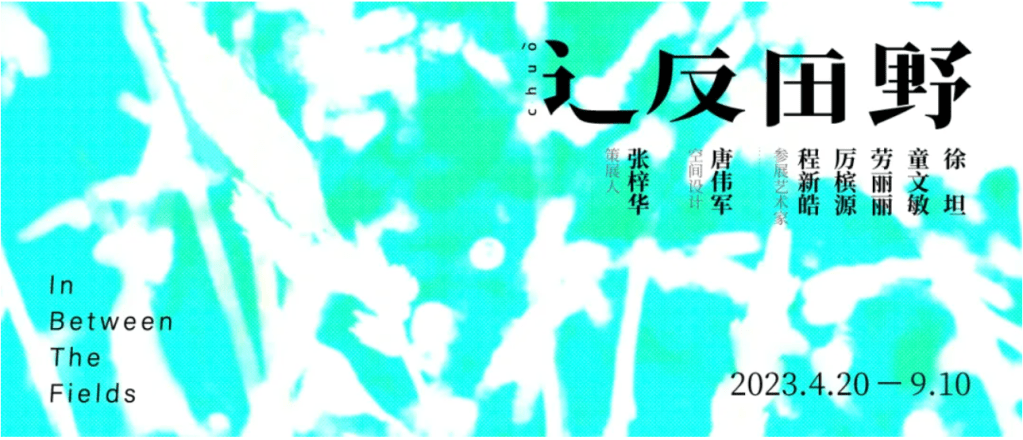
What do artists pay attention to when they return to the field to create? What kind of working methods do they use to create? This sharing session will invite and ask the artist and a landscape architect to summarise a key word for their creative practice over the years.
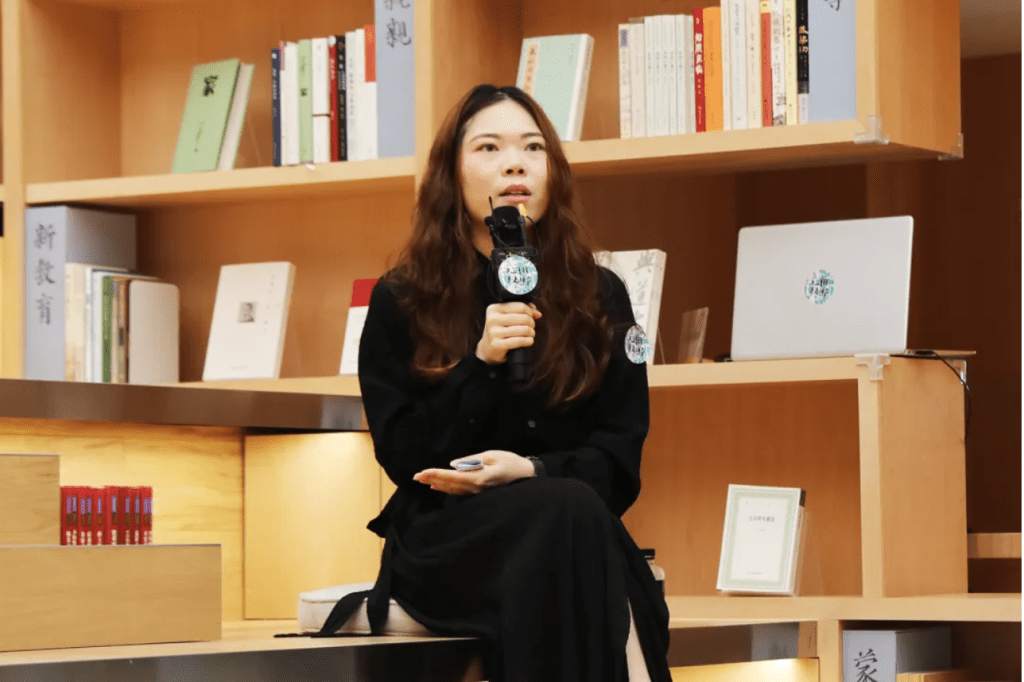
In Between The Fields 辶反田野
The Chinese term ‘辶反田野’ (In Between The Fields) comes from an anthropological book of the same name. The character ‘辶’ has the fluid intention of walking away and stopping, and running around, while ‘反’ means to oppose, reflect on, and also to rush to and return from. ‘辶反’ very much reflects our working state. I used to work in the art media, often going out to interview and communicate with different artists and art museum staff. Looking back at this exhibition, the five artists also use the method of “辶反” to connect their creations with the pulse of the times, which I think is a very important characteristic of the exhibition.
In response to the rural characteristics of Longtou Village, where the Spring Terrace is located, the focus of the exhibition is on the fields. The overt theme is a literal narrative of fields and fields: each artist focuses on a different ‘field’ object. Some focus on the ethics of the land, some on the living conditions and personal wisdom of fishermen, some on the history and geography of the place, some on personal identity issues, and some on the natural landscape. Their creations reflect different degrees of physical perception of the field.
The underlying theme shows to some extent how the artists use anthropological fieldwork methods to approach their artistic subjects, open up the local area, and create works that transcend the boundaries of their disciplines. The entire exhibition forms a paradoxical and entangled field of heterotopia through the overlapping and interweaving of ‘reversal’ and ‘return’, which creates contrasts and differences between different fields. It is both down-to-earth and detached from reality, and it attempts to call on people to transcend the confines of their rooms, open up their individual perceptions, and create a more universal vision of place and a stable sense of self.
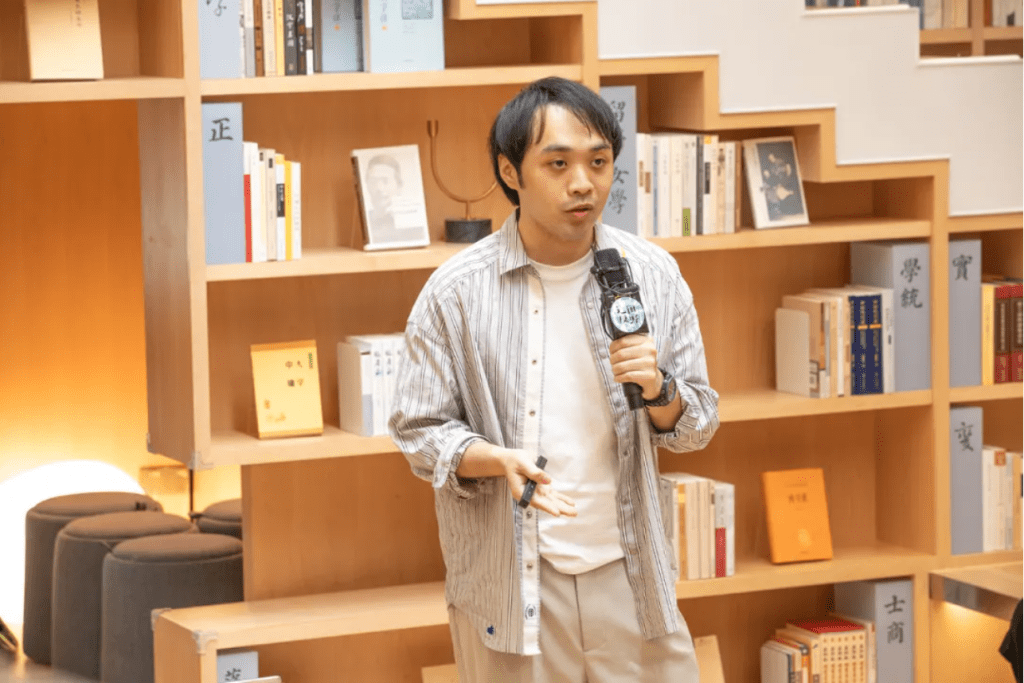
Dialogue 对话
The concept of the exhibition space design attempts to respond to the exhibition theme on the one hand, and also attempts to dialogue with Chunyang Terrace and Longtou Village on the other: First, the architectural features of the ‘skylights’ and ‘vertical windows’ of Chunyang Terrace are used to define the layout of the exhibition hall. The semi-curved walls and the setting of the terrace in the space divide the space into two groups of scenes: ‘field’ and ‘field’. The skylight shines through the windows and onto the walls, enhancing the sense of layering in the space. people will unconsciously look out of the windows towards Longtou Village, thus creating a sense of place for the fields. In response to the theme of the exhibition, I created a circulation route guided by the walls to emphasise ‘migration’, and emphasised ‘looking back’ through the technique of framing the garden. This causes the action of walking back and forth to happen continuously during the exhibition, bringing a sense of physical perception to the audience from a spatial level.
In addition, the ‘large bonsai’ set up in front of the exhibition area, the ‘daily life on the river’ video at the foot of the scarecrow, and the metal floor of the combined exhibition area are all ‘amplifiers’ for the artworks. The off-white shell powder wall mixed with dry straw is hoped to arouse the audience’s imagination of the fields.
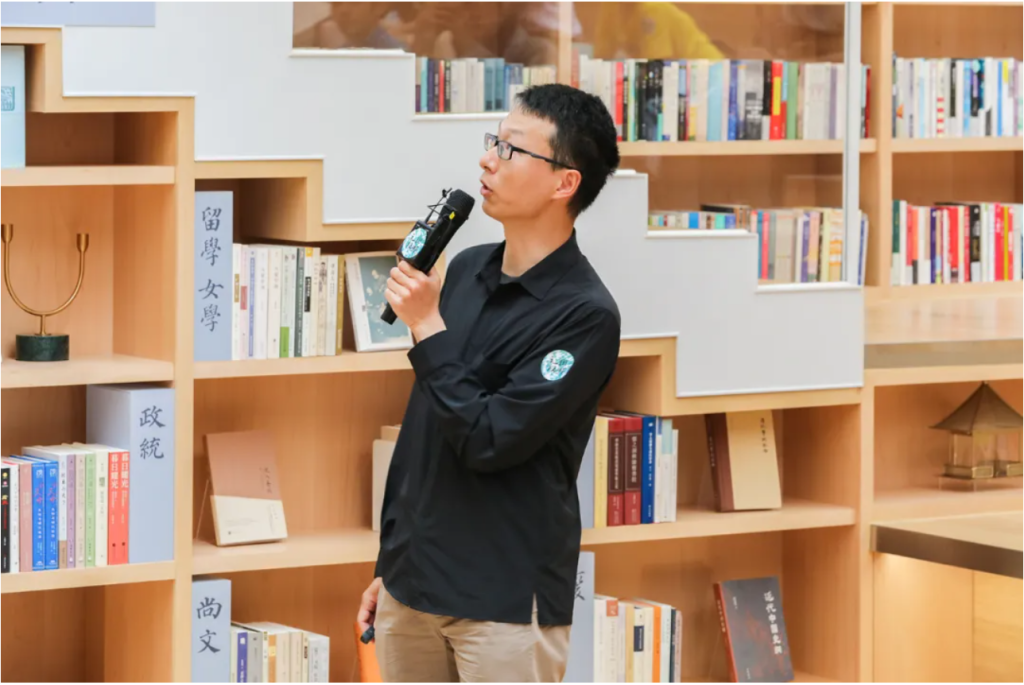
Encounter 遭遇
Walking is the way I express my work, but walking does not mean that I cannot conduct fieldwork. Anthropological fieldwork requires a fixed point and continuity over time, and an in-depth understanding of the location. However, I believe that roads may require a different approach to fieldwork, which does not just focus on specific locations or closed communities, but more importantly, on the ‘encounters’ with various things and events that occur on the road.
I wish to emphasise this encounter in the field. Some are predetermined, such as the inevitable encounter with the train on the train track, where the perception of the body connects with the mechanical perception. But more likely, it is an accidental encounter. For example, the cow by the railway suddenly broke the hiking pole I was using, which caused a series of problems for me in the rest of the journey.
Through the lens, I tried to capture such chance encounters. For example, on the Bira Snow Mountain, I encountered pre-modern flocks of sheep and donkeys that still carry goods on the road. I saw new cables relying on the infrastructure of the past, with pack horses carrying materials to build new power towers, and the physical bodies of the horses bearing new weights.
In the work on the Burma Road, I tried to capture my encounters with stones, passing vehicles, barking stray dogs, creatures covering the road surface, etc. These layered experiences were drawn out during the crossing and made perceptible. My key word is ‘encounter’, which is also what I tried to convey through my body as a medium during the walk, so that everyone could feel things related to a particular road and a specific journey.

Non-Stop 营役
About ten years ago, the development of high-speed rail in Hong Kong began. Many people wondered if this society would develop so quickly that many things would disappear. At that time, none of us were farmers, and neither were any of our family members. We didn’t really think about what we should protect.
At that time, we thought, ‘Why don’t we go back to the countryside and learn from the villagers? They themselves have a lot of life skills, such as building houses and growing vegetables. They can live independently, and it seems that a very small community already satisfies them. Why are the villagers so content? Is it because they don’t need much capital to live in the countryside, so they don’t need to earn so much money?
This is of course an idealised image. When we actually farm, it’s a different story.
Our team is not large, and there is a village in Hong Kong called Choi Yuen Village, where people have been farming for 13 years now. Every day we work non-stop, and there is no end in sight. I often wonder why we feel so tired in the fields and in the office. We call this ‘military service’. Why do we feel this way?
At the beginning, we didn’t farm for the money. We just wanted to try more and learn more. But as the team grew, everyone went in different directions. Some people think we’ve gone back to the countryside, just selling vegetables and not doing anything else. But I don’t think that’s absolutely true. We’re all connected to what’s going on in the outside world.
As some people join, others leave, and there are always people asking us how we are going to move forward. I once asked a friend in the team, and this is what he said: “The usual embellishment is to say that everyone is like-minded and so on, but in fact, this thing does not exist. A profound example is when you talk about each taking what they need. This word ‘营役’ (non-stop) is derogatory in many situations. It feels like taking advantage. But I would feel that it is very accurate to explain why our group got together. In fact this is a bit of a case of putting the cart before the horse. The word ‘营役’ (non-stop) contains the middle word ‘involuntary’. We try to be an autonomous person, but we feel that ‘non-stop’ is what crosses this autonomy?”
I think this is a kind of summary. Many times we don’t really think about what we want to do. For example, someone says that we need to put the okara and fertilizer here, but you don’t think about why you need to do it, you just do what he tells you. In fact, you don’t really have a relationship with the plants, you don’t feel capable, you don’t know why you are in this team, you just follow other people’s imagination. Maybe it is because of this kind of situation that you feel very busy and have lost your autonomy.

Spiritual Connection
I have recently become interested in spiritual connection. I particularly need to connect my spirit with other things, and I am also thinking about what ways there are. In fact, I haven’t figured out the question of spiritual connection myself. The thing about spirit is that it is very abstract, and spiritual needs and expressions are very hidden. I can’t explain it clearly at the moment. This time, I’m trying to talk about my creative process in the past to see if I can glimpse some traces of spiritual connection.
For example, with ‘Sea Waves’, I was in a very relaxed state when I went to Malaysia for a residency. The sea was my material, because I mainly do performance art, so I had to connect with it. When I was lying on the shore, my whole body was in a relaxed state, but also highly sensitive. My eyes were closed, and I could only rely on my hearing. At this time, my hearing became very sensitive. Sometimes I heard the roar of the waves, which seemed particularly loud, and I thought the waves were definitely coming, but in fact they never touched me at all. Sometimes it seemed like there was no sound at all, but the waves suddenly hit me, as if I was waiting for the unknown to arrive.
In fact, I can tell you how I create each work and why I create it in this way, but it is difficult for me to withdraw from the identity of an artist and look at this person and why she has such strange behaviour. Because I feel that behind it is a very spiritual need, and that spiritual need at each moment is actually very vague for me.
My recent project, From South to North, why did I do it? It’s because I spent a year collecting weeds in the same place. Maybe it was spring, the sun was shining, the plants were especially green, and that changed my mood. A choice was made, and it changed the course of a story. I feel that these very abstract elements of nature, such as the wind, temperature, and humidity in the air, actually have a very concrete impact on our daily lives, but they are easily overlooked and difficult to describe.
Maybe it’s the climate on a larger scale, but I’m not trying to describe that kind of thing. These things are like some kind of abstract spirit in you. I’ve recently come to like a saying that roughly means that only when the spirit is involved in something can a person feel stability, security and strength.
The Emperor’s New Clothes 皇帝的新衣
My interests mainly focus on how to integrate the aesthetics and perception of art with social research. We talk about contemporary art and how perception, aesthetics and science can be combined with social research. I think social research is a broad field, and for artists, this field is even more boundless, because artists’ work does not have disciplinary boundaries.
The humanities we talk about include anthropology, sociology, etc., but sometimes people question the work of artists. They may ask if certain works can be called “research”. I think that as long as the work involves social cognition, it can be called ‘research’.
But I find that some of the issues I have involved are often criticized by many people. I did a project called ‘Endurance, Animal Nature, Freedom’ in Guangdong. The phrase ‘animal nature freedom’ has made many people criticize me, saying that I have reduced humans to the level of animal nature. I have not reduced humans, I have only emphasized the freedom of biological nature, which includes the freedom we often talk about, but in fact the difference is very large.
In Greek mythology, people are all tall, handsome and beautiful, like the sun god and Venus, while animals are a completely different type of creature for them. Therefore, when Westerners see the word ‘animal nature’, they think we are belittling humans. But I think in Chinese civilisation, each of us has animal attributes. For example, I am a dog, I am a chicken, and what am I? This is all about our close connection with animals, which is part of our culture and the way we see the world.
I have been exploring the meaning of ‘freedom’ and ‘animal nature’ for a long time, trying to find answers from different perspectives and among different people. This exploration has not stopped, and I am still continuing.
I have also started to pay attention to some practical issues, such as contemporary agricultural production and seeds. I have found that nowadays many farmers use industrially produced seeds, and they have very few seeds of their own. I asked some old farmers, and they said that they can only keep four or five kinds of seeds for planting. I think this is very important for us Chinese people, because seeds represent the continuation of life. You have heard the saying, ‘This person has the seed,’ which refers to a man’s courage and perseverance. This ‘seed’ probably refers to the seed.
We often see advertisements for ‘paternity testing’ on the street, and we often hear that a man who has been tested and found out that his child is not his ‘seed’ immediately gives up the child. On the other hand, I have also discovered a kind of contradiction. We Chinese attach great importance to our bloodline and our own seed, but we can destroy our natural environment at will. This is a very strange phenomenon. I just want to know, if you destroy nature like this, will your seed still be ‘original’? Will your bloodline still be pure?
It seems to me that we may be the last generation of native humans. Everything we do and all the damage we do to the world will eventually come back to us.
When we really face society, we will find that the truth is not what we think it is. I often say that the society we see is like the scene of a teenager seeing that the emperor is actually naked. So, no matter how old you are, you should face the world like a teenager. This is the necessity of my work, and this is why I do these things.
*For the Chinese translation, please click on the original URL. Available at: https://mp.weixin.qq.com/s/7dtyhHOcTfDY1B8Xdi_HYQ
