by Nicole Zihua Zhang
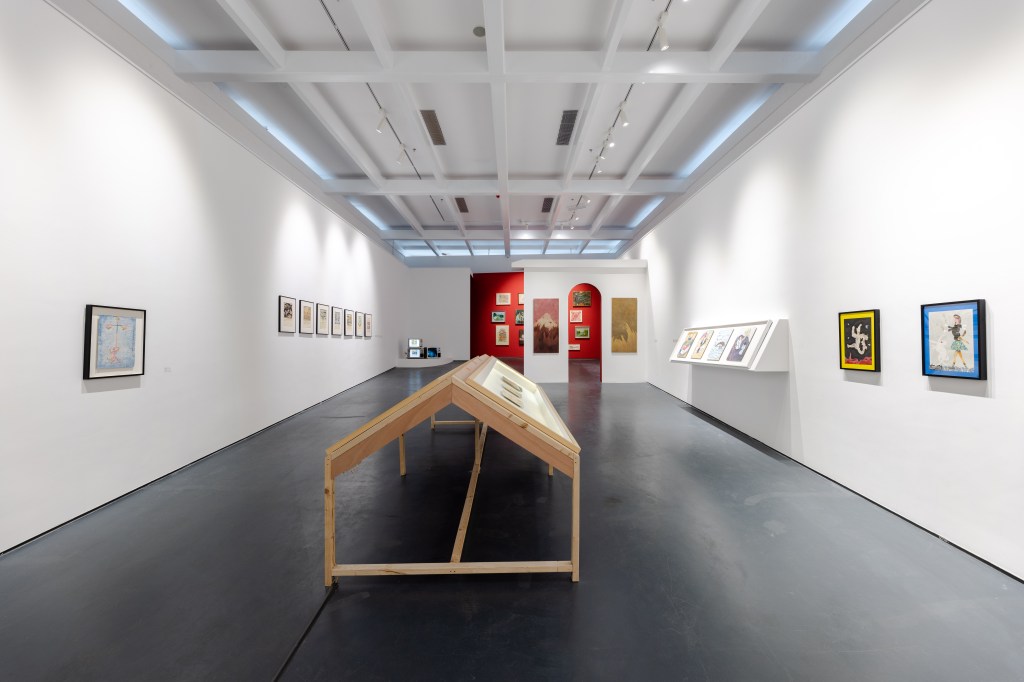
Psychologist Mihaly Csikszentmihalyi describes a state of complete involvement and immersion in an activity as a flow experience. At a particular moment or in a particular environment, artists may feel the urge and passion to create. This emotion and motivation will drive them to fully immerse themselves in their creations, experiencing lasting joy and self-fulfilment. ‘Follow Your Heart’, curated by Yang Tange, gently reveals the freedom of creation and the relaxed flow of experience in the zigzagging museum space. The title of the exhibition is a classical and broad concept, so the curator focuses on the correspondence between “interest” and “aftertaste”. Through the narrative of folk stories, the reflexivity of art’s detachment from traditional norms is hinted at.
The narrative of the exhibition gradually transitions from the abstract to the concrete. In the first room, Zhang Wei‘s abstract experimental works combine painting with media such as shovels, light bulbs, chains and paper fan surfaces. His early experience of joining the No Name Painting Society anchored his playful energy and rebellious attitude, causing him to drift between different art forms and styles and challenge orthodox aesthetic concepts. Similarly, Liu Dongxu explores new media culture in the form of sculpture. His experimental installations, which combine organic food-grade soybeans and metal materials, deconstruct the traditional functions and meanings of objects, and attempt to fill the new spatial balance he has created with light. The works of the two artists together create an ambiguous atmosphere, like layers of clouds and mist that draw the viewer into uncertainty. It is only when you approach the works of Cao Yingbin and Han Yong that the fog slowly dissipates – the images in the works begin to take on concrete shapes. Cao Yingbin incorporates the classical forms he learned from travelling to temples, churches and art galleries into his paintings, conveying a sense of pure observation and a subtle sense of religion and sublimity through simple lines and light colours. This is a direct, unpremeditated expression of the real world, showing the inner world of the creator in a naïve, unconscious way. His paintings form a dialogue with those of Han Yong. In Han Yong‘s work, the picture is also outlined with awkward and simple thick lines, but he pays more attention to the profound language of colours, so that the paintings are full of intuitive expressions of a pious attitude and a pure religious feeling. His small paintings on ancient bricks, tiles and stone blocks guide the viewer into a mysterious scene in the form of primitivism.
The new retelling of Journey to the West forms another layer of narrative in the exhibition. The work breaks with the characterisation of the original work and inspires the viewer’s reverie about the story’s fictionalisation, while also inviting contemplation of the logic behind the juxtaposition of these heterogeneous works. Ma Ke‘s “Journey to the West – May I Ask Where the Way is?”, blurs the perspective of the space. Through expressionist techniques, large areas of colour are used to create the feeling of dusk as the sun sets in the west. The monk Tang Seng and his four disciples become the focal point of the painting. The geometrical structure of the “small” figures dissolves any meta-narratives. The simplified drawing of Pigsy becomes an index of this escape, providing an artistic experience of wandering thoughts. ‘Nezha’s Mind’ and “Flame Mountain”, painted by Cao Yingbin 20 years ago, are like a diptych. From a distance, they appear to be a tranquil scene of water and fire. Only when you get close to the picture can you faintly see Nezha, as small as an ant, “fiercely fighting”. The artist’s temperament is bursting out. In the Monkey King series, Ding Liren‘s Monkey King wears modern clothes and uses a long pole to “do acrobatics” with insects. Now over 90 years old, he has spent his entire life creating artistic interpretations of the Journey to the West and his experiences working at the Institute of Entomology of the Chinese Academy of Sciences in the 1960s. The most thorough combination of this Chinese classical literary myth with modern artistic techniques is Zhang Guangyu‘s “A Comic Book of the Journey to the West”. He uses the name “Journey to the West” and the characters in it as a basis to satirise current issues. In the picture book, it can be seen that he uses the form of comics, and incorporates techniques such as silhouette, Egyptian art, cubism, and surrealism, to bring “Journey to the West” into a new narrative in a global context.
At the end of the main exhibition hall, paintings ‘carefully selected’ from Dafen Village in Shenzhen are on display. The curator deliberately added to the exhibition’s ‘local flavour’ to connect with the creators. Whether they are professionally trained or have acquired their skills through self-study, they can all show the original and innocent ‘naïve beauty’ in a natural state. This sense of ‘aftertaste’ draws the tone of the exhibition to a purely subjective feeling. However, the reasons for this inspiration vary from person to person, and it is difficult for us to describe the specific contours of ‘inspiration’. At this moment, from the perspective of everyday objects to classical literature, in the playfulness of language, the ‘aftertaste’ can be the self-affirmation of the person involved, or it can also be the meaning woven by the viewer on the ground.
*For the Chinese translation, please click on the original URL. Available at: https://mp.weixin.qq.com/s/6HsO1JZc2qHk1Y35j_L4Bw
