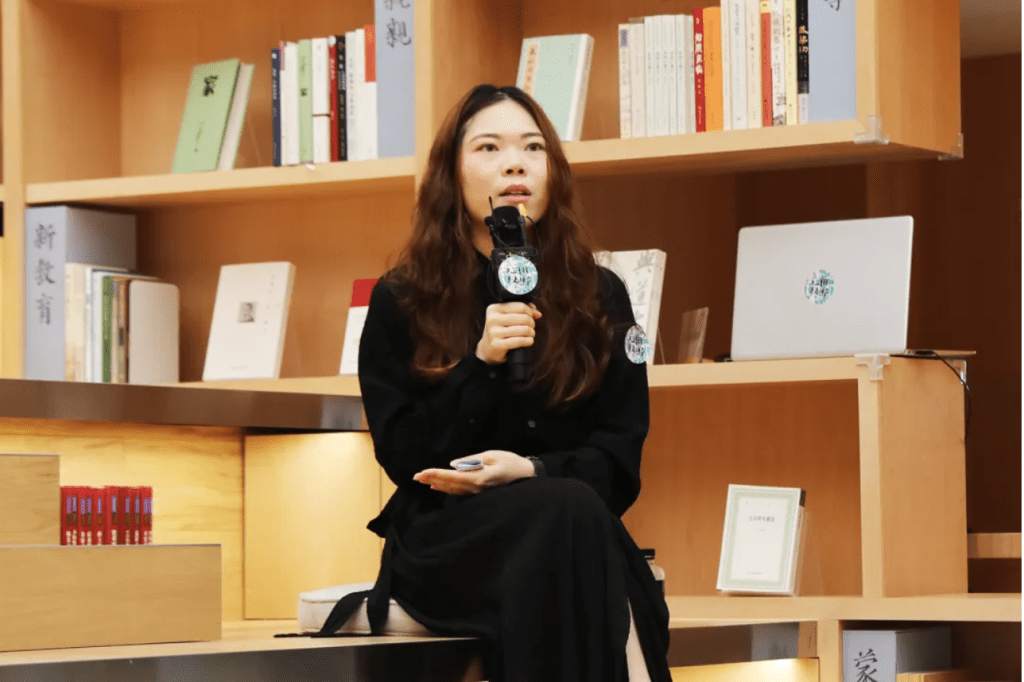
Interview by ChunYangTai Art and Culture Centre, 2023
*
As a novice curator, Zhang Zihua faced great challenges in the work of the ‘Field of Departure’ exhibition: limited time, limited space, and a relatively closed proposition.
Fortunately, hard work pays off, and in this exploration of the theme of ‘field’, Zhang Zihua finally found the concept of ‘field of departure’.
‘Field of departure’ means opposition and reflection, as well as rush and return.
Thus, what seemed like an abstract and complex concept was woven by curator Zhang Zihua to present a near-pure state: using the field to re-activate the senses, the overlap of ‘reverse’ and ‘return’ constructs a field heterotopia full of contradictions and entanglements.
*

Q&A
Chunyangtai: In the past two or three years, cultural events such as museums and exhibitions have become more and more integrated into everyday life, and the profession of ‘curator’ has also begun to be perceived by the public. In your understanding, what do you think a ‘curator’ should be like?
Nicole: I believe that professional curators first need to understand works of art, be familiar with art history, and have a sense of problem and a critical spirit. On this basis, they can master and flexibly apply the two methodological strategies of ‘strong curation’ and ‘weak curation’, present different narratives and meanings, and become dynamic elements that leverage the art ecosystem.
Chunyangtai: In Between The Fields is a contemporary art exhibition. How would a viewer without any relevant background understand this exhibition?
Nicole: When faced with a contemporary art exhibition, many viewers will first fall into the habitual thinking of ‘what is the artist saying?’ and expect someone to provide a definitive answer.
In fact, the charm of a contemporary art exhibition lies in its openness, and I believe in everyone’s powers of observation, understanding and judgement. Viewers with relevant academic backgrounds can draw on their expertise and reflect on and critique the academic issues involved in the exhibition;for ordinary viewers, they can boldly use their imagination and try to connect their personal experiences and emotions with the artworks.
The ‘Field of Departure’ exhibition is a ‘strong curation’ that organises the structure of the exhibition, selects artists and works, and designs the space and interaction with the audience around the concept of ‘Field of Departure’. From the beginning to the end of the planning process, I constantly reviewed and revised myself, and ultimately constructed a field heterotopia using a non-essentialist methodology to present the open-and-close responses of the five artists to the ‘field’ and to try to hint at the artistic value of ‘corporality’.
If the works in the exhibition can awaken everyone’s embodied encounters or some flashes of insight, then the purpose of the exhibition will have been achieved. Therefore, I would like to hear the voices of every visitor to the exhibition and understand what they have read in the exhibition.
Chunyangtai: What challenges do you see in presenting contemporary art in an old village with a traditional historical context?
Nicole: Holding a contemporary art exhibition in an ancient village has the potential to stimulate experimental curation. This kind of experimentation can expand and connect the curator’s knowledge and vision of various disciplines such as history, geography, and anthropology. It is a kind of cross-over attempt. The biggest challenge is that the curator has to think and weigh the artwork’s artistry and locality in particular, and be vigilant in avoiding making the exhibition an airborne one.
Chunyangtai: How would you interpret the theme of this exhibition, ‘In Between The Fields’?
Nicole: As I described in the exhibition essay, the term ‘辶反田野’ (In Between The Fields) comes from an anthropological book of the same name. The character ‘辶’ has the fluid meaning of walking away, stopping, and running, and ‘辶反’ means to oppose, reflect, and also to rush and return. The five artists who have been creating works in the field for a long time – Cheng Xinhao, Li Binyuan, Lo Lai Lai Natalie, Tong Wenmin and Xu Tan – each focus on a different subject in the field, and their creations reflect their perception of the field with varying degrees of physicality. The exhibition attempts to trace the rhythm of the intertwining of the artists‘ lives and the fields, and even the rhythm of the fields themselves. Contrasts and differences between the fields are formed through the overlapping and interweaving of “reversal” and “return”, thus constructing a heterotopia of the fields full of contradictions and entanglements. “Reverse Field” reflects on the fields and provides a contemporary response, while “Return to the Field” is the artists’ contemplation of ‘returning’ to the fields.
Chunyangtai: The works in this exhibition are mainly video-based, and most of the participating artists have backgrounds in anthropology or performance art. This is very different from the usual art exhibitions that focus on paintings, sculptures and other works. What are your thoughts on this?
Nicole: This is the result of “doing nothing”. When I received the invitation to exhibit, I reached a consensus with the Chunyangtai Art and Culture Centre: to plan an exhibition related to the countryside. However, I did not want to limit the positioning of my exhibition to this, but rather hoped to respond with the open dimension of the ‘field’. When inviting artists, I did not deliberately choose artists whose main artistic expression was images. On the contrary, in terms of physical space and time considerations, how do you come up with an exhibition plan for a space of about 100 square metres in a short period of time? This determined that the volume of the artists on display could not be too large, and the types of media in the works should not be too many. In terms of content orientation, my own research interest in interdisciplinary methods guided me to seek this artistic aesthetic in the exhibition I curated. After many communications, I finally invited these five artists, whose artistic characteristics are different and whose fit with the theme of the exhibition is the highest.
Chunyangtai: In this curation, in addition to your personal participation, the spatial designer Tang Weijun also played a very important role. How did you collaborate with the spatial designer to create this exhibition?
Nicole: Tang Weijun, who is responsible for the design of the exhibition space, is a landscape architect. Unlike the architect who is generally perceived as building a ‘container’, he has extensive experience in the design of public space transformation and has a unique understanding of nature and publicness. Focusing on the exhibition theme of ‘field of movement’, he guides the actions and lines of sight of the viewer through the movement of the walls and the window design, creating a double ‘field of movement’. The wall materials of straw and shells and the undulating wall shapes, combined with potted plants and a video of the river surface, amplify the visual perception of the ‘field’. This spatial design solution makes the exhibition flow more smoothly and complements the narrative level of the entire exhibition space.
Chunyangtai: You used to work mainly as a writer for art media, and have in-depth communication with many artists. Does this have a unique influence on curatorial work?
Nicole: The participating artists are all those I have long followed and come to know well through my previous media work. As a result, the entire curatorial communication process went very smoothly, and I am very grateful to these senior artists for their trust in me as a novice curator. This development from art writing to curatorial work can be traced back to the emergence of the first group of curators in China in the 1980s (such as Li Xianting and Gao Minglu). At that time, there was no curatorial major in art academies in China, and there was no profession of curator. Art exhibitions were mainly curated by artists or art critics, many of whom had senior magazine editing and writing experience. This also reflects the professional ability that curators need to have in critical writing.
*For the Chinese translation, please click on the original URL. Available at: https://mp.weixin.qq.com/s/XrU0b02mkWr7bbmlyy6aPg
